

The business I never built
In 2016, while running Paygroup, Nathan saw an opportunity to support UK recruitment agencies placing people on construction projects in the United States. The idea became AmChex.
The chapter describes a potential cohort of roughly 1,000 workers and a possible fee of £500 per worker per month. Those figures were the opportunity Nathan imagined. They were not earned revenue, a proven price or a profit forecast.
After about three months of research, the idea stopped moving. The practical questions were difficult to resolve: employment, immigration, payroll, insurance, different state requirements and the people needed to deliver the service.
The chapter asks what changes when you can bring AI into that work. Its 48-hour framing is about producing useful research and artefacts you can inspect. It is not a claim that a regulated US employment business can become operational in 48 hours.
Reopening the brief
Nathan returned to the idea with the original Figma website draft and asked for a plan for everything needed to launch it. One exact request in this revisit was:
Make a plan for building the AMChex business from Scratch.
The work developed into a complete book example: a website to explore, research to question, resources to reuse and an administration plan showing what would sit behind the service.
AmChex remains a worked example. It is not a trading business, and no customer placement or partner approval is implied. The enquiry form is a demonstration for fictional information only. The address nathan@amchex.com is illustrative and unmonitored.
What you can explore
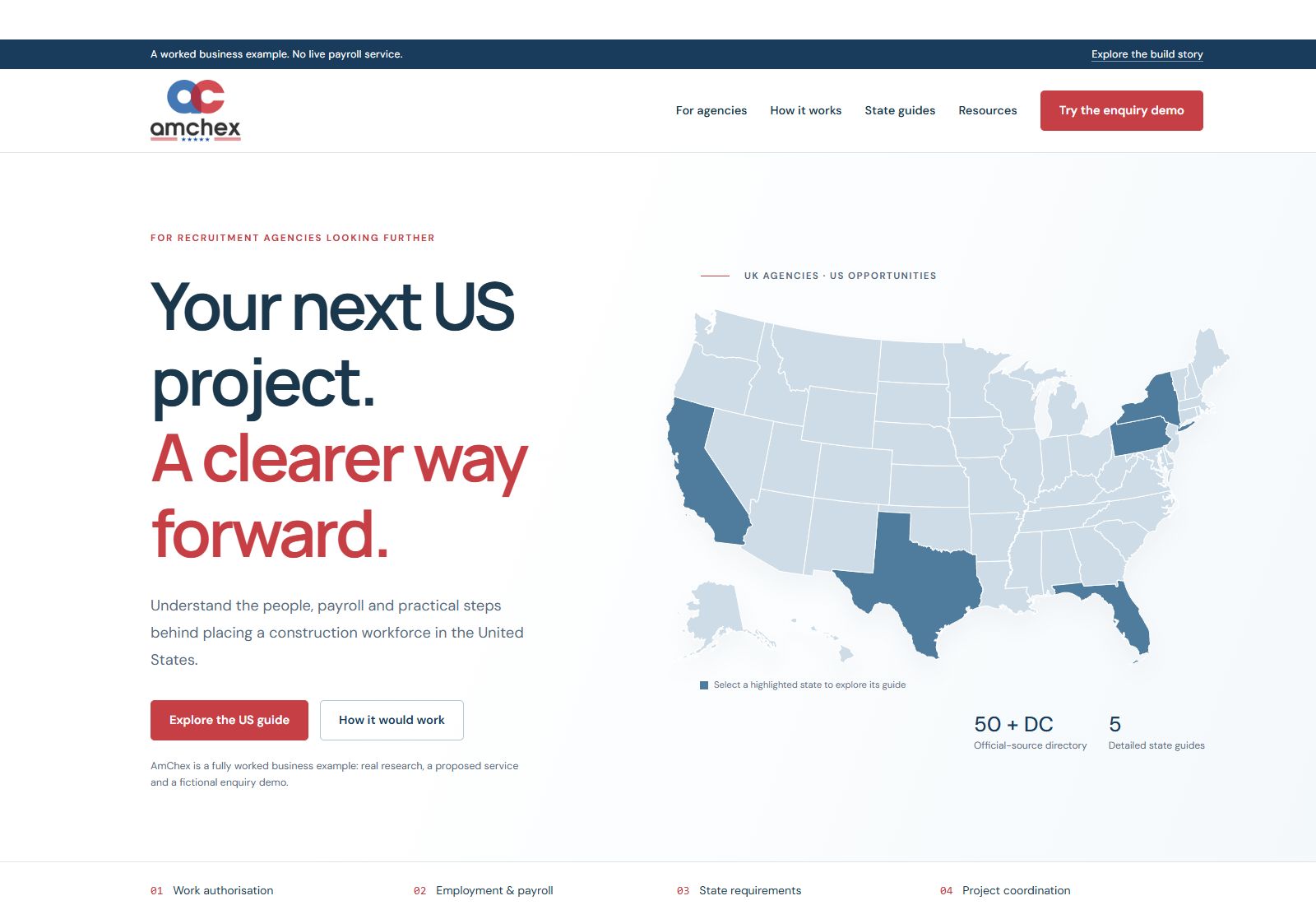
The example website turns the original brief into something readers can explore.
- The AmChex example website: the proposed service, research, resources and a fictional project-enquiry demonstration.
- An official-source directory covering all 50 US states and the District of Columbia, plus five deeper state guides. These help organise further research; they do not establish permission to operate.
- The business setup playbook: customer validation, supplier candidates, responsibilities, contracts, insurance, cost modelling and the conditions for a real launch.
- The sample resource pack: a two-page prospectus, six-slide presentation, readiness checklist, six LinkedIn drafts, three email drafts and reusable graphics.
- The future administration specification: enquiries, contacts, partner evidence, project readiness, tasks, approvals, research maintenance and finance handoff.
The website includes a small owner inbox for fictional enquiries. The full administration system is specified for a later stage, rather than presented as already built. The pack's PowerPoint is editable, and the printable PDFs are finished sample materials.
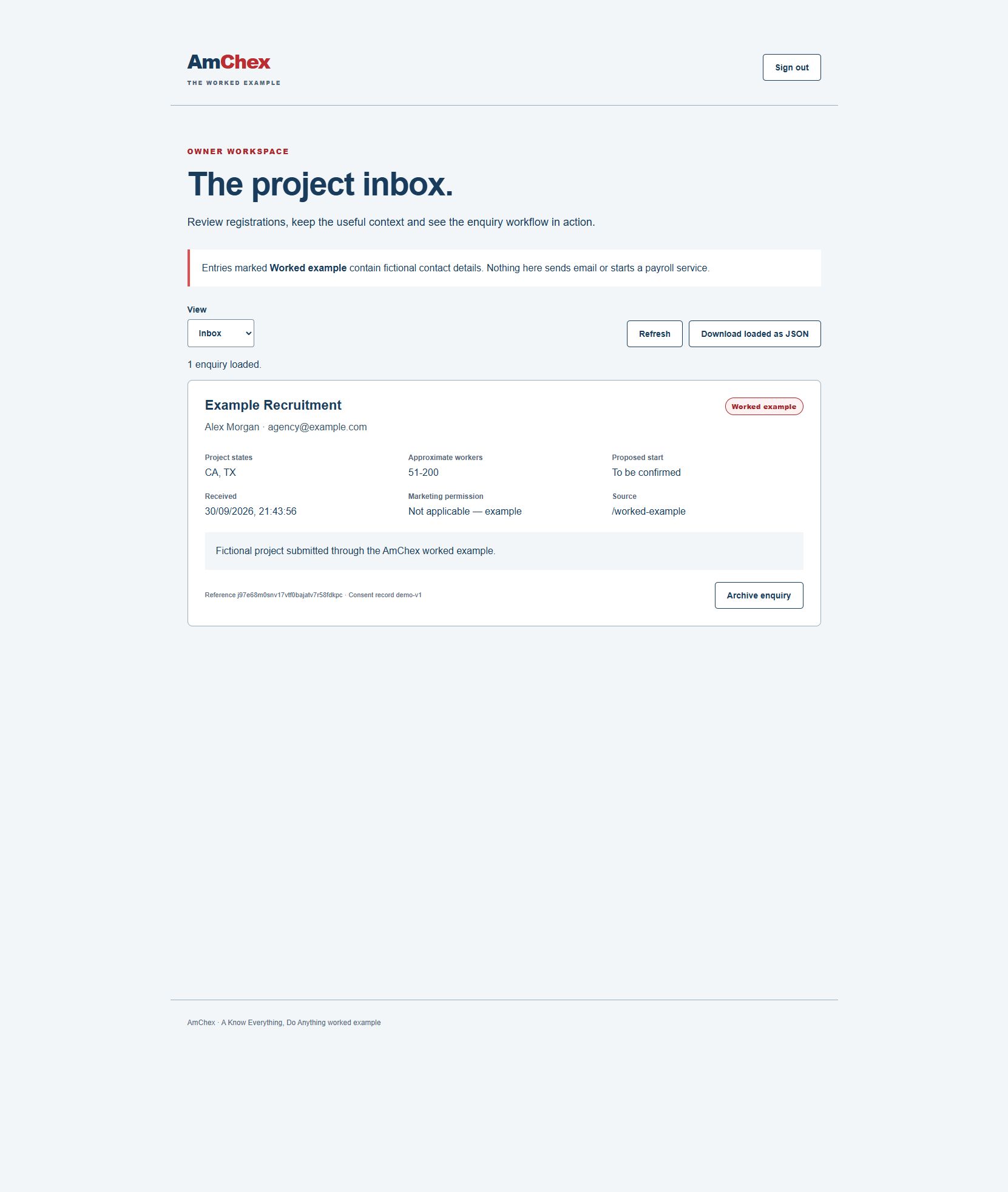
This screenshot shows the fictional enquiry after it reached the owner inbox. The demonstration does not send email or start a payroll service.
The decisions behind the example
The intended customer became more specific: a UK recruitment agency considering a defined US construction project. The proposed first service is coordination with specialist delivery partners. AmChex would help turn a rough request into an assessable brief, identify who owns each responsibility and track what still needs a decision.
That matters because payroll, legal employment and immigration are different responsibilities. The plan does not assume that buying an employer-of-record service automatically supplies a lawful worker route, insurance for every trade or funding for every client.
The supplier research identifies real candidates, including providers that advertise construction or staffing services. It records the remaining questions alongside the evidence. A supplier appearing in the research has not agreed to support AmChex or a particular cohort.
The historic £500 fee remains a hypothesis. The financial plan separates AmChex's possible service revenue from partner fees, employment costs, mobilisation expenses and the cash needed before a client pays. It requires actual quotes before any commitment.
The work in a repeatable sequence
- Recover the idea. Read the chapter and original design brief. Identify what the business was meant to do and which questions stopped it.
- Narrow the first case. Describe one agency, client, state, trade group and project. Give specialists concrete facts to assess.
- Research the delivery path. Use primary sources and real supplier materials. Record what they establish and what they leave unanswered.
- Make reviewable artefacts. Build the example website, draft marketing materials, readiness checklist and commercial playbook.
- Design the administration. Define records, owners, evidence and approval gates before treating a larger system as a software build.
- Check the work. Review source access, render documents, test the enquiry backend and inspect the website. Keep the example separate from any future commercial launch.
What was checked, and what remains open
The prospectus, checklist, slides and social graphics were rendered and visually reviewed. Fourteen backend tests passed during development. The published example's main routes and downloads were checked, and the production enquiry workflow was tested, including the fictional-data gate, duplicate handling and protected owner inbox. These checks support the example's technical quality; they do not certify worker eligibility, legal compliance or business feasibility.
The research pass encountered automated-access limitations on 33 source URLs. The current Texas TxUS workflow remains unverified. An access limitation is not evidence that a rule is absent or that an official source is wrong. A real project would need a person to verify current requirements with the relevant authority and qualified advisers.
Before a real launch, the owner would still need a validated customer need, an accepted worker route, written supplier coverage, company and licensing decisions, contracts, insurance, secure records and sufficient funding. A finished website is evidence of a finished website.
Reusable prompts
The prompts below are reconstructed for readers from the approach used in this example. They are not a verbatim transcript of the historical work. Replace the details with your own project and use fictional or anonymised information.
Reconstructed prompt 1: turn an idea into a research brief
I have a business idea that stalled because I could not resolve the practical requirements. Read my notes and explain the intended customer, problem and proposed service. Separate facts from assumptions. Identify the questions that determine whether the business is feasible. Start with one narrow pilot case and tell me what evidence a qualified adviser or supplier would need to assess it. Do not assume that a website or a supplier's marketing claims prove the business can operate.
Reconstructed prompt 2: make the first version concrete
Use this brief and reference design to build a clearly labelled worked example. Include the website, an enquiry demonstration using fictional details, sample marketing resources and a business setup playbook. Make every link and download usable. Keep unsupported prices, client claims and supplier approvals out of the copy. Explain which parts are working examples and which remain plans.
Reconstructed prompt 3: design the work behind the website
Specify the administration needed to run the proposed service. Cover enquiries, organisations, contacts, supplier capabilities, project readiness, tasks, evidence, approvals and finance handoff. Give every important decision an owner. Define how changes or expired evidence reopen a review. Minimise personal data and keep specialist legal, immigration and payroll decisions with the responsible professionals. Include acceptance scenarios before any real pilot.
Reconstructed prompt 4: review the result
Review the example against its brief. Verify links and downloads, inspect the rendered documents and test the main demonstration. List research that could not be verified. Distinguish a passing technical check from a commercial or legal conclusion. Tell me which evidence is still required before a real launch, and correct claims that imply more progress than the work supports.
Try it with your own unfinished idea
Choose an idea you stopped pursuing because the research or setup felt too large. Explain the result you wanted and where the work got stuck. Ask for one concrete artefact you can inspect, then use it to make the next decision.
For AmChex, that has produced a substantial example people can explore. Whether it should become a real business is a further decision, supported by a much clearer set of questions.